

Coway News & Promotion
Is Filtered Water Actually Safe?


A guide to filtration methods, reverse osmosis, certifications, and how U.S. public water systems work
You can't tell whether water is safe just by looking at it.
Beyond visible sediment, tap water may contain lead, arsenic, nitrates and nitrites, fluoride, total dissolved solids (TDS), and trace contaminants like PFAS — a group of chemicals that has drawn growing attention in recent years.
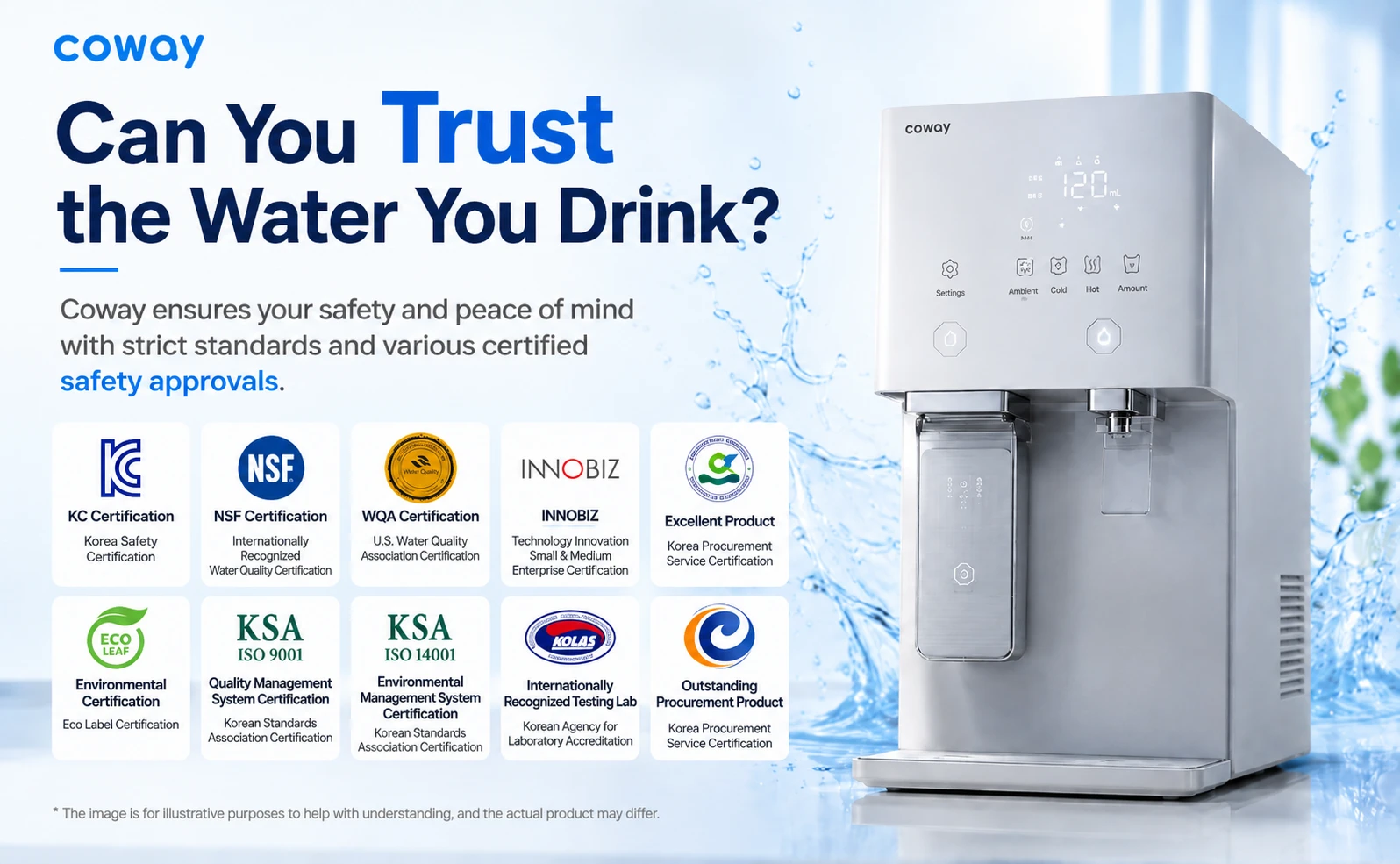
That's why choosing a water purifier isn't about the brand name or how many filters it has. What matters is the filtration method it uses, which contaminants it has been tested to reduce, and whether that performance has been verified by an independent third party.
Note that PFAS certifications currently focus on two specific compounds — PFOA and PFOS — rather than the full family of PFAS chemicals.
1. How do water filters actually work?
Home water purifiers rely on a few core technologies.
Activated Carbon
Activated carbon is full of microscopic pores that adsorb certain substances from water. It's widely used to reduce chlorine and improve taste and odor, and depending on the product design and certification scope, it can also reduce some organic compounds and specific contaminants.
It does not remove everything dissolved in water.
Ion Exchange
This method selectively captures certain ions or swaps them for others. It's used to treat hardness minerals and some metals and ionic contaminants.
UV Sterilization
Ultraviolet light inactivates microorganisms. Useful for microbial control, but it doesn't physically remove dissolved chemicals like lead, arsenic, or salts.
Reverse Osmosis (RO)
RO applies pressure to force water through a semipermeable membrane. Water that passes through is separated from the concentrated stream that doesn't, which reduces a wide range of dissolved substances.
According to the EPA, home RO systems can — depending on design and performance — remove contaminants including lead, VOCs, PFAS, arsenic, and certain bacteria and viruses.
2. How does RO actually filter water?
In natural osmosis, water moves across a semipermeable membrane on its own. RO applies pressure to reverse that flow.
Source water → Pre-filter → RO Membrane → Filtered water
→ Post-filter → Drinking water
Substances that can't pass through the membrane are flushed out with the concentrate stream.
So an RO system does more than strain out particles like a sieve. It reduces a range of substances that are dissolved in the water itself.

3. What contaminants does reverse osmosis remove?
The main advantage of RO is the breadth of contaminants it can address.
Depending on the product and its certified performance, RO systems may be used to reduce:
- Lead
- Arsenic
- Cadmium
- Chromium
- Copper
- Fluoride
- Nitrate / Nitrite
- Selenium
- Radium
- Total Dissolved Solids (TDS)
- Certain PFAS compounds
- A range of other dissolved contaminants
This does not mean every RO system removes all of the above equally.
Actual performance varies with the membrane itself, the pre- and post-filter configuration, source water conditions, flow rate, pressure, and whether filters have been replaced on schedule.
So before you buy, check which specific contaminants that particular product has been certified to reduce.

4. PFAS and RO
PFAS — often called "forever chemicals" — is a family of compounds that has drawn increasing scrutiny.
When choosing a filter for PFAS reduction, the EPA recommends checking the product label and the certifying body's database. For RO systems specifically, look for a certification such as NSF/ANSI 58 that includes an actual PFAS reduction claim.
In other words: the fact that a product says "RO" on the box matters far less than whether it carries certified reduction performance for the specific contaminant you care about.
5. What do NSF/ANSI 42, 53, and 58 mean?
NSF/ANSI 42
Covers aesthetic water quality — taste and odor. Chlorine taste and odor reduction is a typical claim under this standard.
NSF/ANSI 53
The main standard for health-related contaminant reduction.
Don't stop at "NSF 53 certified." Check which specific contaminants the product is certified to reduce.
NSF/ANSI 58
One of the most important standards to check for an RO system.
NSF's certification database shows product-by-product reduction claims for systems certified to NSF/ANSI 58 — TDS, lead, arsenic, barium, cadmium, chromium, copper, fluoride, nitrate/nitrite, radium, selenium, and more.
So when comparing RO systems, rather than settling for:
"Uses NSF-certified filters"
ask:
"Which specific NSF/ANSI 58 claims is the complete system certified for?"
The distinction matters. A certified filter inside an uncertified system is not the same thing.
6. Check the certifying body too
NSF isn't the only independent organization evaluating drinking water treatment products in the U.S.
For PFAS reduction filters, the EPA points to product listings from these third-party certifiers:
NSF / WQA / IAPMO R&T / UL / CSA Group
When you're comparing products, the most reliable approach isn't reading the marketing copy. It's looking up the model number directly in the certifier's database and reading the certified contaminant reduction claims for yourself.

7. Is RO only used in home water filters?
No.
Here's something worth knowing: RO is used at scale in U.S. public drinking water production and water supply facilities.
| Location | Facility | Purpose | Capacity |
|---|---|---|---|
| Orange County, CA | Groundwater Replenishment System (GWRS) | Advanced treatment for groundwater replenishment | Up to 130 million gallons/day |
| Carlsbad, San Diego County, CA | Claude "Bud" Lewis Carlsbad Desalination Plant | Seawater → drinking water | ~50 million gallons/day |
| Santa Barbara, CA | Charles E. Meyer Desalination Plant | Seawater → drinking water | ~3 million gallons/day |
| El Paso, TX | Kay Bailey Hutchison Desalination Plant | Brackish groundwater → drinking water | Up to 27.5 million gallons/day |
| Multiple locations, TX | Municipal brackish-water desalination facilities | Brackish groundwater → municipal supply | Managed by the Texas Water Development Board |
8. So is RO water automatically better?
This is where some balance is needed.
RO is a powerful filtration technology, but "it's RO" alone doesn't make every product equally safe or effective.
Along with dissolved contaminants, RO can also reduce minerals like calcium and magnesium.
The process also produces a concentrate stream, so water efficiency is worth considering. According to the EPA, some existing home RO systems may discharge roughly a gallon of water for every gallon they produce. Newer designs have improved on this.
And no matter how capable the system, performance depends on replacing filters and the RO membrane on schedule.
9. "Doesn't removing minerals make water less healthy?"
This question comes up often.
It's true that RO can lower the concentration of some minerals.
But water isn't your only source of nutrients — most minerals come from food. And some RO systems include a post-treatment or mineral adjustment stage after filtration.
In fact, large-scale facilities that use heavy RO treatment do the same thing. Orange County's GWRS adds minerals back after filtration to stabilize the water before it goes into the ground.
10. A checklist for choosing a water purifier
Six questions worth asking.
① What filtration method does it use?
Activated carbon, ultrafiltration, or reverse osmosis?
② Is the complete system third-party certified?
Look up the actual model number in a certifier's database — NSF, WQA, IAPMO.
③ Which contaminants is it certified to reduce?
Don't stop at the NSF logo. Check whether the certification covers lead, PFAS, arsenic, TDS, or whatever matters for your water.
④ What's the filter and membrane replacement schedule?
Performance depends heavily on maintenance.
⑤ What's the output volume and wastewater ratio?
Worth comparing, especially for RO systems.
⑥ Are the wetted parts themselves certified safe?


