

Coway News & Promotion
Is an Air Purifier Just for Dust?

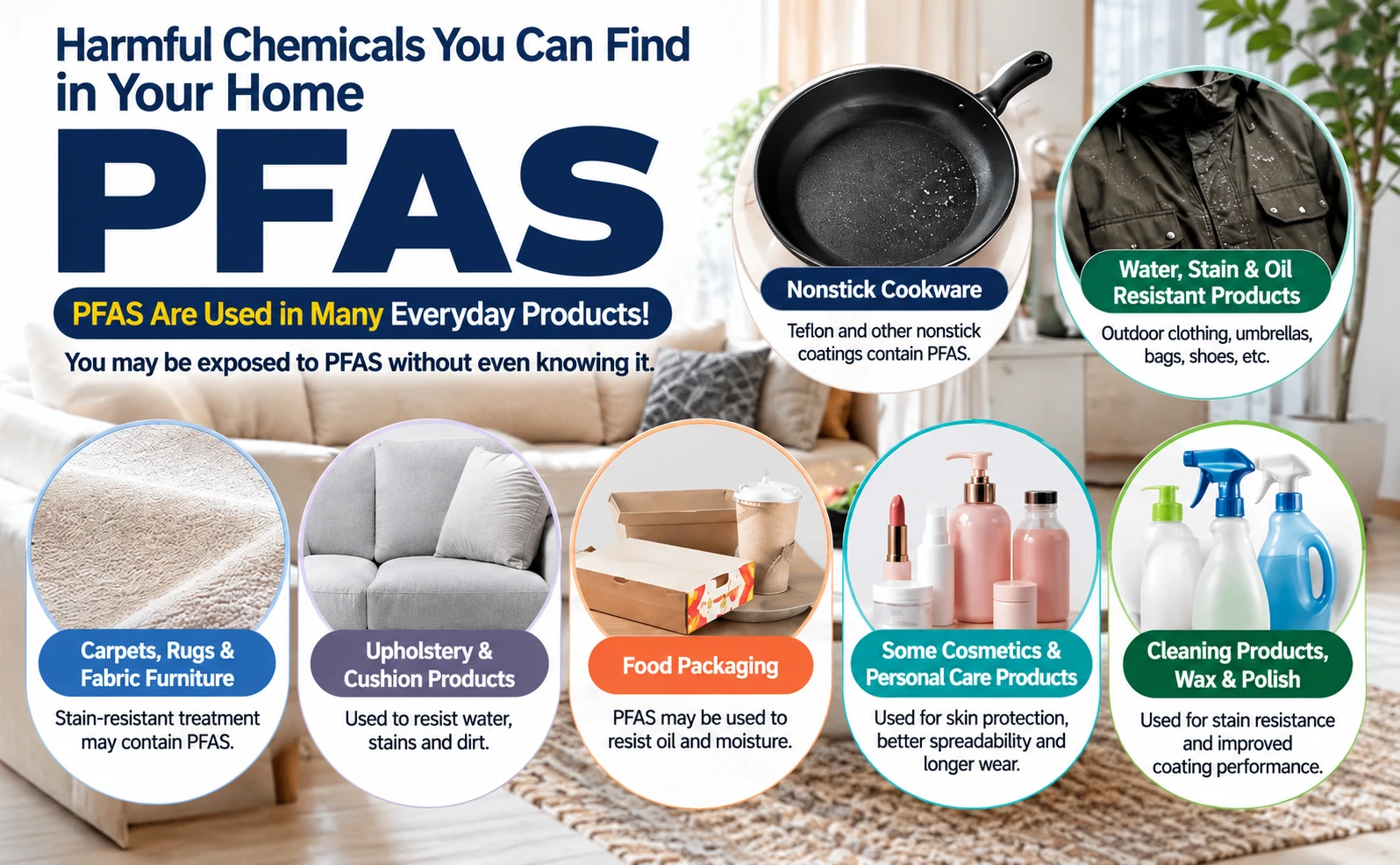
Is water the only thing to worry about?
Text after title text example
Per- and polyfluoroalkyl substances — often called "forever chemicals" in the news — resist water, oil, and heat, and they don't break down easily. That combination made them useful in a wide range of products: waterproof and water-repellent gear, stain-resistant carpet and furniture, some food packaging, and various household goods.
The reason PFAS draws so much attention is exactly that durability. These compounds persist in the environment for a very long time.
PFAS = chemicals that don't go away easily
Exposure can happen through water, but also through food, consumer products, indoor dust, and air.


💧 Are PFAS only in water?
When people hear PFAS, contaminated water is usually the first thing that comes to mind.
But the EPA lists several exposure pathways beyond drinking water — consumer products, food packaging, and indoor air and dust among them.
Recent research has detected a range of PFAS compounds in indoor air and household dust. Given how much time most of us spend indoors, the indoor environment is being studied as one of the exposure pathways worth paying attention to.
🏠 How do PFAS get into indoor air?
Carpet, furniture, household products
↓
Dust and fine particles are generated
↓
They circulate into the air
↓
Potential exposure through breathing or contact with dust
Not all PFAS exist in the air the same way. Some are found as gases. Others are carried on indoor dust or attached to small particles.
Which is why managing the air you breathe and the dust in your home matters alongside managing your water.
🧹 How to reduce indoor PFAS exposure
Avoiding PFAS entirely isn't realistic. What you can do is lower the chances of exposure through everyday habits.
① Clean up dust regularly
Vacuum and wipe floors and carpet so settled dust doesn't get kicked back into the air.
② Ventilate
On days when the weather and outdoor air quality are good, open windows to let accumulated indoor pollutants out.
③ Choose PFAS-free products
Where possible, look for household goods labeled PFAS-free. It's one way to reduce overall exposure.
④ Run an air purifier
Continuously filtering fine dust and airborne particles helps with indoor air management.
🌿 Can a HEPA filter capture PFAS?
Air purifiers don't handle every pollutant the same way. What filter system a unit uses makes the difference.
Coway Airmega purifiers use a multi-stage filter system — depending on the model, a combination of a pre-filter, HEPA filter, and activated carbon filter.
1️⃣ Pre-filter
Catches dust and larger particles first, protecting the filters behind it.
2️⃣ HEPA filter
Captures fine airborne particles.
Since some PFAS can be present in indoor dust and particles, continuous air management with a HEPA filter can help from the standpoint of reducing airborne dust and fine particles that may carry PFAS.
3️⃣ Activated carbon filter
Where the HEPA filter captures particles, the carbon filter adsorbs odors and some gases and volatile organic compounds (VOCs).
So the work is divided:
Large dust          → Pre-filter
Fine particles      → HEPA filter
Odors, some gases   → Activated carbon filter
💨 What does an air purifier actually do?
The benefit isn't just that the room smells better.
Coway's multi-stage system continuously captures airborne dust and fine particles, while the carbon filter handles odors and some gas-phase pollutants alongside.
Some models include an Auto Mode that senses indoor air quality and adjusts fan speed as needed, so the air keeps getting managed without you adjusting anything.
In spaces where you spend long stretches of time — kids' rooms, bedrooms, the living room — cleaning once isn't the end of it. Dust and particles get stirred back into the air, and filtering them continuously is what keeps up.
🌎 PFAS management doesn't stop at water
Drinking water and food remain the primary exposure routes. That doesn't change.
But there's no reason to ignore the indoor air and dust you're surrounded by for most of the day.
- Manage your water
- Reduce household dust
- Choose PFAS-free products
- Ventilate
- Filter airborne particles continuously with an air purifier
No single measure solves PFAS exposure. Reducing the pathways one at a time is the realistic approach — and a Coway air purifier can be one part of that.
🌿 Clean air matters as much as clean water
You manage the water you drink every day. Do the same for the air you breathe.
Note: An air purifier is not a device that completely removes all forms of PFAS, and this does not mean Coway's standard HEPA and activated carbon filters guarantee a specific removal rate for any particular PFAS compound. This article describes indoor dust and airborne particle management.


